All countries

Silfio country intelligence · HRV

Croatia

1.0% annual probability
Croatia flag
Population

3.88M

GDP

$105.06B

Currency

EUR

Capital

Zagreb

Land area

56.59K km²

Official languages

Croatian

Risk assessment

Risk profile

The 12-month probability of a new armed conflict on Croatian territory is 1.0%, representing a minimal risk. Croatia’s history of war during the 1990s remains the most important background factor, but its EU and NATO membership, consolidated state institutions, and comparatively strong economic and security capacity provide substantial protection against renewed internal or interstate violence.

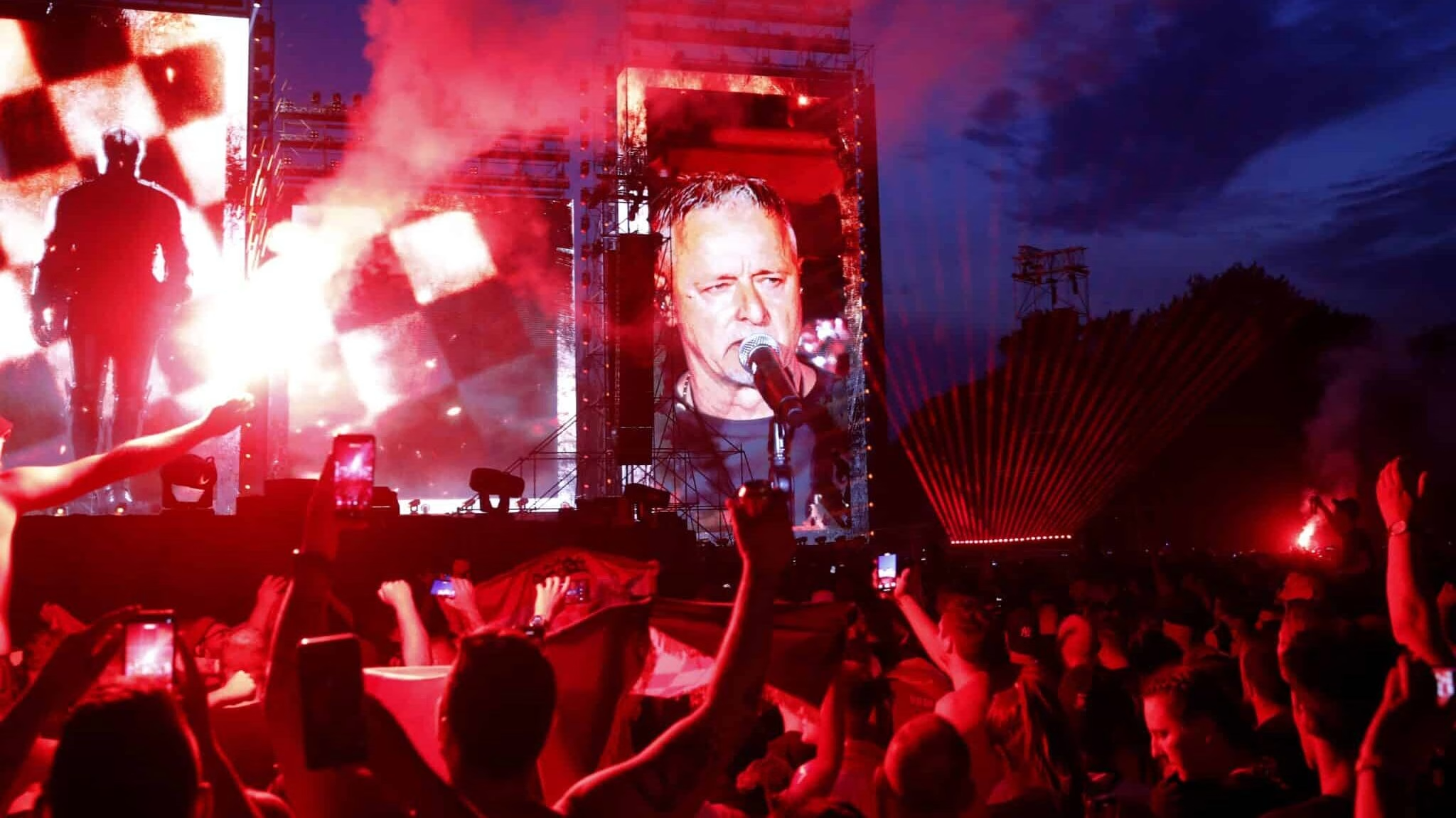
Recent reporting shows political and societal friction with Serbia over Croatian singer Marko Perković Thompson, whom Serbian officials associate with Ustasha symbolism and alleged neonazi sympathies. His planned performance for roughly 500,000 people has prompted condemnation from Serbia, but the episode currently indicates nationalist tension rather than organised armed mobilisation or an operational threat to Croatian territory.

The largest uncertainty is whether nationalist disputes could become linked to a broader deterioration in Croatia–Serbia relations or violence involving organised extremist groups. Risk would rise most clearly with cross-border attacks, sustained communal violence, or armed mobilisation inside Croatia; it would fall further with continued institutional management of contentious events and stable relations among Croatia, Serbia, and their European partners.

Strategic reasoning

  • Croatia’s 1990s armed-conflict history leaves a relevant precedent for nationalist escalation, but EU and NATO membership, capable institutions, and deterrence make a new domestic or interstate war substantially difficult to initiate.
  • Serbia’s condemnation of Thompson’s concert is the clearest current escalatory signal, while the absence of reported armed mobilisation or sustained violence indicates that the dispute remains political and symbolic rather than an onset of conflict.
  • Any fighting involving Croatian forces abroad would not itself qualify; the relevant threshold is armed violence occurring on Croatian territory.

Critical indicators

  • In reporting dated around 1 September 2026, Serbia condemned Thompson’s planned Croatian concert, expected to draw about 500,000 people, citing his alleged sympathy for the World War II Ustasha regime. The dispute could sharpen nationalist rhetoric but does not by itself demonstrate armed escalation.
  • Croatia’s 1991–95 war for independence remains the principal historical precedent for conflict on its territory. The subsequent settlement and Croatia’s accession to NATO in 2009 and the European Union in 2013 provide stronger safeguards against a comparable recurrence.

Probability trend

How the Croatia estimate has moved

Probability1.0%1.0%1.0%

Aug 26

Aug 31

Sep 1

Date

Regional context

Croatia compared with its neighbours and region

Croatia ranks number 112 of 195 in new conflict outbreak risk.

Figures are each country's modelled probability of a new armed conflict on its territory within the next 12 months. Select any country to open its full profile.

Related coverage

Serbia condamnă concertul unei vedete croate pe care o acuză de neonazism: OROARE - Flux24.ro

flux24.ro

Serbia condamnă concertul unei vedete croate pe care o acuză de neonazism: OROARE - Flux24.ro

Read source
