All countries

Silfio country intelligence · PNG

Papua New Guinea

4.4% annual probability
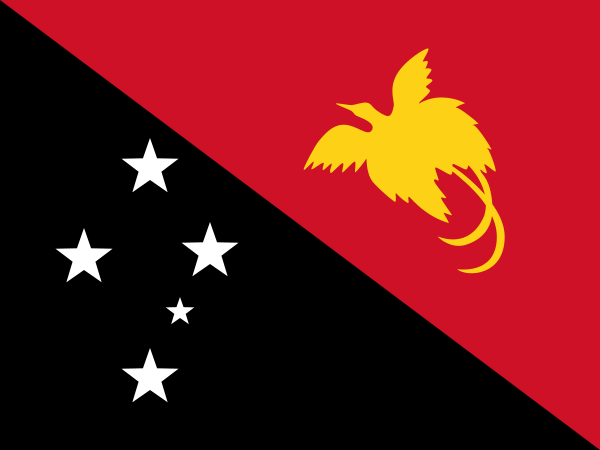
Papua New Guinea flag
Population

10.76M

GDP

$32.5B

Currency

PGK

Capital

Port Moresby

Land area

462.84K km²

Official languages

English, Hiri Motu, Tok Pisin

Risk assessment

Risk profile

Papua New Guinea has a 4.4% 12-month probability of a new armed-conflict onset, placing it in the moderate risk category. The country’s history of communal and tribal fighting, the unresolved Bougainville question, limited state reach across difficult terrain, and weak institutional capacity support a persistent underlying risk of internal violence.

Recent reporting places Prime Minister James Marape within sharper Pacific tensions over great-power rivalry and nuclear testing. His warning that Pacific nations “do not want history repeated,” alongside Australian Prime Minister Anthony Albanese’s description of the test as “provocative” and “destabilizing,” indicates heightened regional friction, but does not itself show fighting on Papua New Guinean territory.

The main uncertainty is whether domestic grievances and local disputes could combine with political instability or outside pressure to produce sustained armed violence. Risk would rise with organized clashes involving national or provincial authorities, renewed Bougainville violence, or major tribal fighting; it would fall with effective mediation, security restraint, and continued containment of regional tensions.

Strategic reasoning

  • Papua New Guinea’s history of tribal conflict and the Bougainville insurgency shows that localized disputes can become prolonged armed confrontations when state institutions and security capacity are weak.
  • Current regional rivalry is an escalatory backdrop involving Papua New Guinea, Australia, and external powers, but foreign tensions and Papua New Guinean criticism of nuclear testing remain distinct from a new conflict on the country’s territory.
  • The principal stabilising factor is the absence of reported sustained interstate or nationwide internal fighting, with political and community mechanisms still available to contain localized violence.

Critical indicators

  • In reporting published on September 1, 2026, Prime Minister James Marape opposed any repetition of the Pacific’s nuclear-testing history, while Australian Prime Minister Anthony Albanese called the test “provocative” and “destabilizing.” The episode raises diplomatic tension but provides no evidence of armed conflict inside Papua New Guinea.
  • The Bougainville conflict, which ended with the 2001 peace agreement after years of insurgency, remains relevant because the unresolved political settlement demonstrates how autonomy disputes and limited state control can generate a new internal-conflict risk if political management fails.

Probability trend

How the Papua New Guinea estimate has moved

Probability4.4%4.3%4.3%

Aug 26

Aug 31

Sep 1

Date

Regional context

Papua New Guinea compared with its neighbours and region

Papua New Guinea ranks number 60 of 195 in new conflict outbreak risk.

Land neighbours

Melanesia

Figures are each country's modelled probability of a new armed conflict on its territory within the next 12 months. Select any country to open its full profile.

Related coverage

How Great Power Rivalry Is Fracturing the Pacific Islands Forum – The Diplomat

thediplomat.com

How Great Power Rivalry Is Fracturing the Pacific Islands Forum – The Diplomat

Read source