All countries

Silfio country intelligence · CUB

Cuba

0.9% annual probability
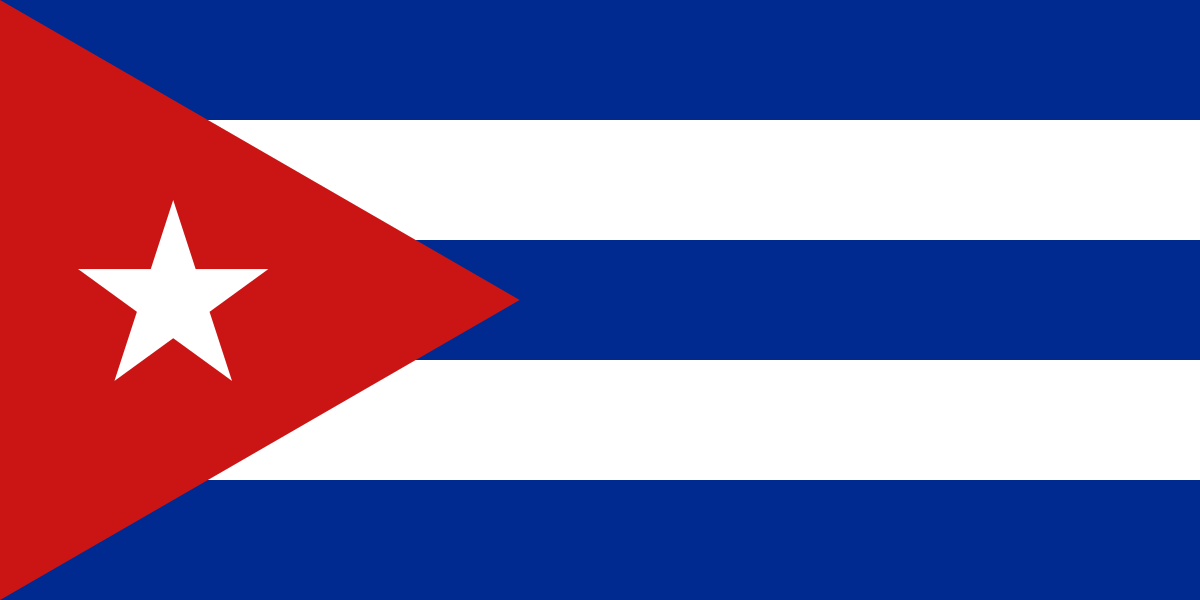
Cuba flag
Population

10.94M

GDP

$107.35B

Currency

CUC

Capital

Havana

Land area

109.88K km²

Official languages

Spanish

Risk assessment

Risk profile

The live 12-month probability is 0.9%, a minimal risk. Cuba’s one-party political system, strong security apparatus, and lack of sustained armed conflict since the revolutionary period support a low likelihood of a new conflict on its territory. Economic hardship and political repression remain relevant sources of domestic tension, but Cuba has historically contained opposition through policing, arrests, and institutional control.

Recent reporting is limited. A 30 August U.S.-Cuba Trade and Economic Council analysis discussed possible U.S. government support for Canadian and Australian mining interests with exposure to Cuban strategic minerals; it did not report military activity or an armed incident. Prediction markets separately price a 14.5% chance of a U.S. strike and 7.0% chance of a U.S. invasion by 31 December, but these contracts cover broader or different outcomes than a confirmed new conflict onset.

The main uncertainty is whether economic pressure, leadership tensions, or a sharp deterioration in U.S.-Cuba relations could overwhelm the state’s established capacity to manage dissent. Risk would rise most clearly after a sustained armed uprising, violent state fragmentation, or a U.S. attack reaching Cuban territory; a negotiated economic opening or continued domestic control would lower escalation pressure.

Strategic reasoning

  • Cuba’s revolutionary-era conflict history is concentrated in the past, while the government retains extensive coercive and administrative capacity. This combination makes isolated unrest more likely to be contained than to develop into sustained armed conflict.
  • Severe economic conditions and political repression can generate public anger, but the recent reporting provides no specific evidence of organized armed opposition or an active interstate confrontation on Cuban territory.
  • The principal external escalation channel is U.S.-Cuba confrontation. Markets assign substantial prices to strikes and clashes, yet those contracts include possibilities that would not necessarily produce a new, sustained conflict in Cuba.

Critical indicators

  • On 30 August 2026, the U.S.-Cuba Trade and Economic Council discussed possible U.S. taxpayer support for Canadian Sherritt and Australia’s Antilles in connection with Cuban strategic minerals. The item indicates continued economic and geopolitical sensitivity, not reported combat.
  • As of 1 September 2026, Polymarket priced a U.S.-Cuba military clash in 2026 at 15.5% and a U.S. strike on Cuba by 31 December at 14.5%, with traded volumes of about $242,000 and $5.2 million respectively. These are relevant indicators of perceived external tension, while the target event requires armed conflict physically occurring in Cuba.

Probability trend

How the Cuba estimate has moved

Probability0.9%0.9%0.9%

Aug 26

Aug 31

Sep 1

Date

Regional context

Cuba compared with its neighbours and region

Cuba ranks number 118 of 195 in new conflict outbreak risk.

Figures are each country's modelled probability of a new armed conflict on its territory within the next 12 months. Select any country to open its full profile.

Related coverage

DOD (War) OSC Could Be U.S. Taxpayer Partner Of Last Resort For Canada’s Sherritt And Australia’s Antilles. Cobalt, Copper, Gold, Nickel, Silver Are Strategic Minerals. — U.S. - Cuba Trade and Economic Council, Inc.

www.cubatrade.org

DOD (War) OSC Could Be U.S. Taxpayer Partner Of Last Resort For Canada’s Sherritt And Australia’s Antilles. Cobalt, Copper, Gold, Nickel, Silver Are Strategic Minerals. — U.S. - Cuba Trade and Economic Council, Inc.

Read source