All countries

Silfio country intelligence · SLV

El Salvador

1.4% annual probability
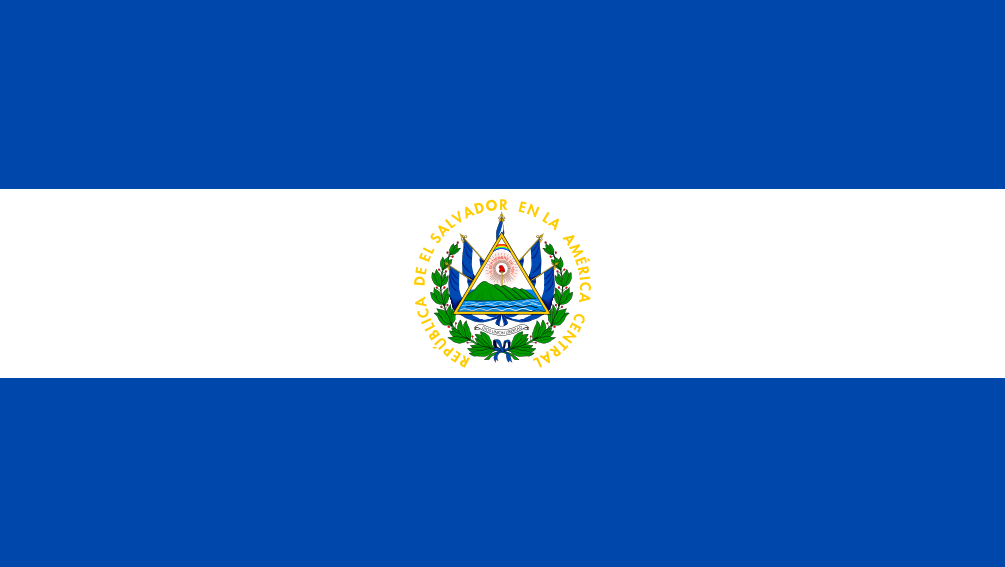
El Salvador flag
Population

6.37M

GDP

$36.71B

Currency

USD

Capital

San Salvador

Land area

21.04K km²

Official languages

Spanish

Risk assessment

Risk profile

El Salvador has a 1.4% 12-month probability of a new armed-conflict onset, placing it in the low-risk category. The country’s principal long-run exposure comes from its history of civil war, recurrent political polarisation, and organised criminal violence, while stronger state capacity and the absence of an active territorial insurgency support a contained-risk assessment.

Recent reporting supplied for 1 September 2026 provides no indication of a new armed mobilisation, cross-border attack, or sustained confrontation involving the government, opposition forces, gangs, or neighbouring states. The principal relevant actors remain the Salvadoran state and domestic criminal organisations; violence involving them would qualify only if it developed into sustained armed conflict, rather than continuing law-enforcement operations or isolated incidents.

The largest uncertainty is whether political or security pressure could produce organised armed resistance, particularly if state authority weakened or a major faction mobilised. Risk would rise with coordinated attacks, territorial seizure, defections by security forces, or external military involvement on Salvadoran soil; it would fall with continued state control and the absence of sustained armed group mobilisation.

Strategic reasoning

  • El Salvador’s 1979–1992 civil war and later gang violence demonstrate a historical capacity for severe internal violence, but the post-1992 state has retained national territorial institutions and no current insurgency is identified.
  • The strongest stabilising factor is the absence of reported mobilisation by domestic armed factions or neighbouring states. Criminal violence and coercive policing remain analytically distinct from a new armed-conflict onset unless they become sustained organised fighting.

Critical indicators

  • The Salvadoran Civil War ended with the 16 January 1992 Chapultepec Peace Accords. The settlement removed the principal insurgent–state war that had defined the country’s modern conflict history, while leaving governance and security vulnerabilities.
  • The 2012 truce between the country’s principal gangs, Mara Salvatrucha and Barrio 18, showed that organised groups could affect national security conditions, but its collapse did not itself constitute a new civil war. It remains relevant as evidence of latent armed-group capacity rather than current conflict onset.

Probability trend

How the El Salvador estimate has moved

Probability1.6%1.5%1.4%

Aug 26

Aug 31

Sep 1

Date

Regional context

El Salvador compared with its neighbours and region

El Salvador ranks number 95 of 195 in new conflict outbreak risk.

Figures are each country's modelled probability of a new armed conflict on its territory within the next 12 months. Select any country to open its full profile.

Related coverage

Israeli strikes on southern Lebanon kill 11 in worst toll since June truce | Lebanon | The Guardian

theguardian.com

Israeli strikes on southern Lebanon kill 11 in worst toll since June truce | Lebanon | The Guardian

Read source
Israel kills 11 in deadliest strikes on Lebanon since June ceasefire

telegraph.co.uk

Israel kills 11 in deadliest strikes on Lebanon since June ceasefire

Read source
Israeli airstrikes on southern Lebanon kill 11 people, Health Ministry says - Los Angeles Times

latimes.com

Israeli airstrikes on southern Lebanon kill 11 people, Health Ministry says - Los Angeles Times

Read source