All countries

Silfio country intelligence · BOL

Bolivia

1.1% annual probability
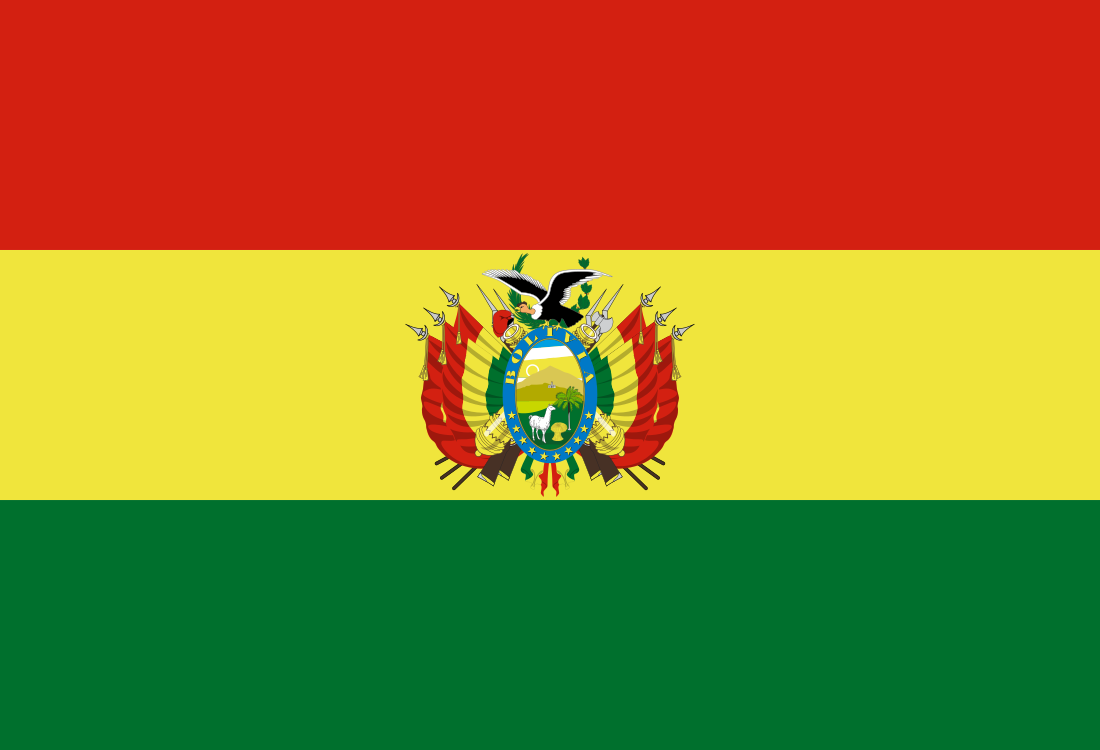
Bolivia flag
Population

12.58M

GDP

$64.77B

Currency

BOB

Capital

Sucre

Land area

1.1M km²

Official languages

Aymara, Guaraní, Quechua, Spanish

Risk assessment

Risk profile

Bolivia’s live 12-month probability of a new armed-conflict onset is 1.1%, making this a low risk. The country has a history of coups, severe political crises, mass protests, and episodes of violent unrest, but these have generally remained below the threshold of sustained civil war or insurgency. Political institutions and state capacity are uneven, while economic and regional tensions can magnify confrontation.

No recent reporting or prediction market provides a specific escalation signal for a new conflict on Bolivian territory. The principal relevant actors would be the national government, opposition movements, social organisations, and security forces; neighbouring states are not currently identified as direct threats.

The largest uncertainty is whether political disputes or economic pressure could produce sustained armed mobilisation rather than protest and short-lived clashes. Risk would rise with organised armed factions, defections within the security forces, or prolonged violence across multiple regions; it would fall with effective political negotiation and containment of unrest through civilian institutions.

Strategic reasoning

  • Bolivia’s record of coups and violent political crises shows that domestic confrontation can escalate quickly, but the absence of a durable insurgency or civil-war organisation supports the low classification.
  • The main escalation pathway is a breakdown between the government, opposition, social movements, and security forces. Existing political channels and the generally limited duration of past violence remain important stabilising factors, while fighting by Bolivian personnel abroad would not constitute a new onset at home.

Critical indicators

  • In November 2019, President Evo Morales resigned after weeks of protests and military and police pressure. The crisis produced serious violence but did not develop into a sustained armed conflict, illustrating both Bolivia’s escalation risk and the limits historically placed on it.
  • The 2003 gas-war crisis and the 2008 regional and political unrest involved deaths, blockades, and confrontations between domestic actors. These episodes remain relevant evidence of latent mobilisation capacity, but neither produced an enduring insurgency or civil war.

Probability trend

How the Bolivia estimate has moved

Probability1.2%1.1%1.1%

Aug 26

Aug 31

Sep 1

Date

Regional context

Bolivia compared with its neighbours and region

Bolivia ranks number 106 of 195 in new conflict outbreak risk.

Figures are each country's modelled probability of a new armed conflict on its territory within the next 12 months. Select any country to open its full profile.

Related coverage

Bolivia's Diesel Protests: What Travelers and Expats Need to Know | The Rio Times

riotimesonline.com

Bolivia's Diesel Protests: What Travelers and Expats Need to Know | The Rio Times

Read source